In Richland Hills, TX, a slow leak behind shower tile can spread fast. Local crews respond to stop the damage, dry the wall and subfloor using IICRC-standard methods, and document findings for plumbing repair or an insurance claim.

Using moisture meters, technicians in Richland Hills map how far water from a tub leak has traveled. They check behind tile, into wall framing, and the subfloor to understand the full scope of the damage.
The crew turns off the water and opens a section of wall or ceiling to reach wet materials. They extract any pooled water around the shower base or tub to prepare the area for thorough drying.
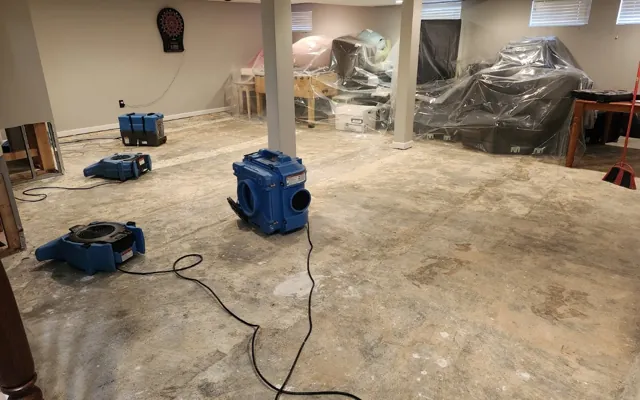
Air movers and dehumidifiers are placed to dry the wall cavity, subfloor, and any affected ceiling below. This process removes the concealed moisture that a slow leak drove deep into the home's structure.

Shower and tub leak cleanup in Richland Hills usually costs between about $700 and $3,500. A recently started leak that only dampened a wall cavity sits at the low end, while a long-running leak that soaked the subfloor and a ceiling on the floor below costs more because more material must be opened and dried. Tile or drywall beyond drying adds repair cost. Sudden leaks are often covered by homeowners insurance, and the crew documents readings and photos for the carrier.
In the compact Mid-Cities suburb of Richland Hills, many homes are 1950s and 1960s ranch houses built on concrete slabs. Original plumbing in these homes, from supply lines to tub drains, is prone to corrosion and leaks. A persistent drip from a shower or tub can soak wall studs, travel into the subfloor, and even damage ceilings below, demanding prompt restoration. In Richland Hills, TX, aging pipes in slab foundations, combined with the area's expansive clay soil that shifts and stresses plumbing, make leaks common. Hard winter freezes can also cause pipes to burst, turning a small drip into a major issue. From Richland Hills, crews also cover nearby Forest Hill, Irving, North Richland Hills, Bedford, Haltom City, Colleyville. See every neighborhood and town on the full service area page.
See all areas servedEvery loss is photographed, measured, and logged from the first visit, so the paperwork holds up with the insurance carrier.
Technicians follow recognized IICRC drying standards and prove it with daily moisture readings on Richland Hills homes, not guesswork.
Emergency dispatch any hour of the day or night, with a real crew on the way across the Mid-Cities, not a callback in the morning.
A real crew dispatched any hour, not a callback in the morning.
Trained technicians following recognized IICRC drying standards.
Truck-mounted, portable, and submersible for any size loss.
The loss is documented and billed to the carrier directly.
Sudden, accidental leaks are often covered. The key is documentation. Local crews provide moisture meter logs and photos of the damage and the drying process, which are essential for the insurance claim. Long-term neglect is typically not covered, so a prompt call is advised.
Drying a wall cavity in a Richland Hills home typically takes two to four days, depending on how far the leak spread and the materials involved. Technicians use meters to track progress and only consider the job complete when the structure meets the dry standard.
Crews are on call 24 hours a day and can be on the way to Richland Hills within the hour.
Call (817) 813-6321