A washing machine overflow or a burst fill hose dumps gallons across the laundry room and into adjoining spaces. Local crews extract the water fast, dry the floors and walls, and verify moisture before it reaches finished rooms.

The crew confirms the water is off, then maps how far the overflow spread across the laundry floor and into adjoining rooms or a ceiling on the level below.
Portable and truck-mounted extractors pull the standing water quickly, since a burst hose can release a large volume that keeps spreading into walls and neighboring rooms.
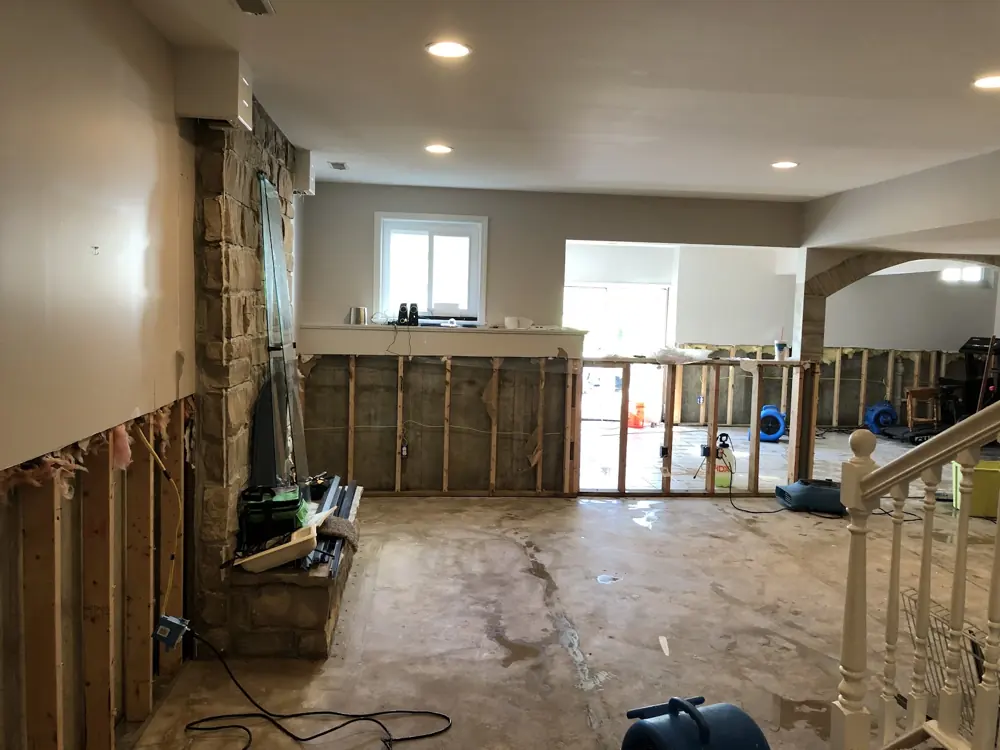
Wet baseboard and lower drywall are opened where the water soaked them, and air movers and a dehumidifier dry the floor, wall bases, and any ceiling below.
Moisture meters confirm the floor, walls, and ceiling are dry, and the readings and photos are logged in case the loss goes to an insurance claim.

While help is on the way, these first steps, done only where it is safe, limit the damage and protect the insurance claim.
Shut the supply off at the source, or close the home's main valve if the source is not obvious. Stopping the flow limits the damage more than anything else.
Switch off electricity to the affected area, but only if the breaker can be reached without standing in or touching the water.
Get a crew dispatched right away. The sooner extraction and drying begin, the more flooring, drywall, and belongings can be saved.
Take photos and a short video of the water and the affected rooms before anything is moved, so the insurance claim starts strong.
Washing machine overflow cleanup in Arlington usually runs from about $700 to $4,000. A quick catch on a laundry floor sits at the low end, while a burst hose that ran for hours and soaked adjoining rooms or a ceiling below runs higher. An upstairs laundry that damaged two floors adds to the total. Sudden overflows and hose failures are commonly covered by homeowners insurance, and the crew documents moisture readings and photos for the carrier.
Crews reach Arlington, Tarrant County, and the surrounding Mid-Cities of North Texas fast, from Central Arlington, Dalworth, and East Arlington to Pantego, Grand Prairie, Mansfield, Hurst, and Euless. See the full list on the areas served across Arlington page.
See all areas servedEvery loss is photographed, measured, and logged from the first visit, so the paperwork holds up with the insurance carrier.
Technicians follow recognized IICRC drying standards and prove it with daily moisture readings on Arlington homes, not guesswork.
Emergency dispatch any hour of the day or night, with a real crew on the way across the Mid-Cities, not a callback in the morning.
A real crew dispatched any hour, not a callback in the morning.
Trained technicians following recognized IICRC drying standards.
Truck-mounted, portable, and submersible for any size loss.
The loss is documented and billed to the carrier directly.
The rubber fill hoses are under constant water pressure whenever the valves are open, and they weaken with age until one splits. A burst hose keeps flowing until the valve is closed, which is why it can flood a home for hours. Braided steel hoses and shutting the valves off help prevent it.
An upstairs overflow finds the subfloor and drips through the ceiling below, so the damage spans two floors. The crew dries the laundry subfloor and the ceiling cavity underneath and verifies both, so the loss does not become sagging drywall or hidden mold weeks later.
Shut off the water valves behind the washer, or the home's main supply, then cut power to the area if it is safe. After that, call for extraction. The faster the standing water is removed, the less it spreads into walls, subfloor, and adjoining rooms.
A sudden, accidental overflow or hose burst is commonly covered under homeowners policies, while a slow, neglected leak may not be. Technicians document the source, moisture readings, and photos so the carrier has clear support when the claim is submitted.
Arlington crews are on call 24 hours a day, local and fast, and can be on the way within the hour.
Call (817) 813-6321